
Pick up two cans of White Fox pouches in Dubai, and you might notice something that doesn’t quite add up. Both carry similar nicotine levels, yet one hits you with a cold, clean burst the moment it touches your lip while the other settles in with a deeper, almost earthy warmth. Neither is stronger in any straightforward sense. They just feel completely different. That gap between what a label says and what you actually experience is what this guide is about
Words like fresh, sweet, dry, and intense come up constantly when people describe White Fox nicotine pouches, yet most of us use them without much thought. They’re sensory shorthand, a quick way to gesture at something happening on your palate that’s genuinely hard to pin down. This article breaks each of those descriptions apart, explains what’s actually driving them, and gives you a practical framework for talking about flavor in a way that’s actually useful when you’re choosing between options
What Do “Fresh,” “Sweet,” “Dry,” and “Intense” Actually Mean?
Before getting into the mechanics, it’s worth establishing what these words mean in a sensory context, because they’re not standardized measurements. There’s no instrument that reads “freshness” off a pouch. These are descriptions of how flavor lands on your perception, shaped by a combination of ingredients, physical sensation, and your own taste profile on a given day.
Fresh
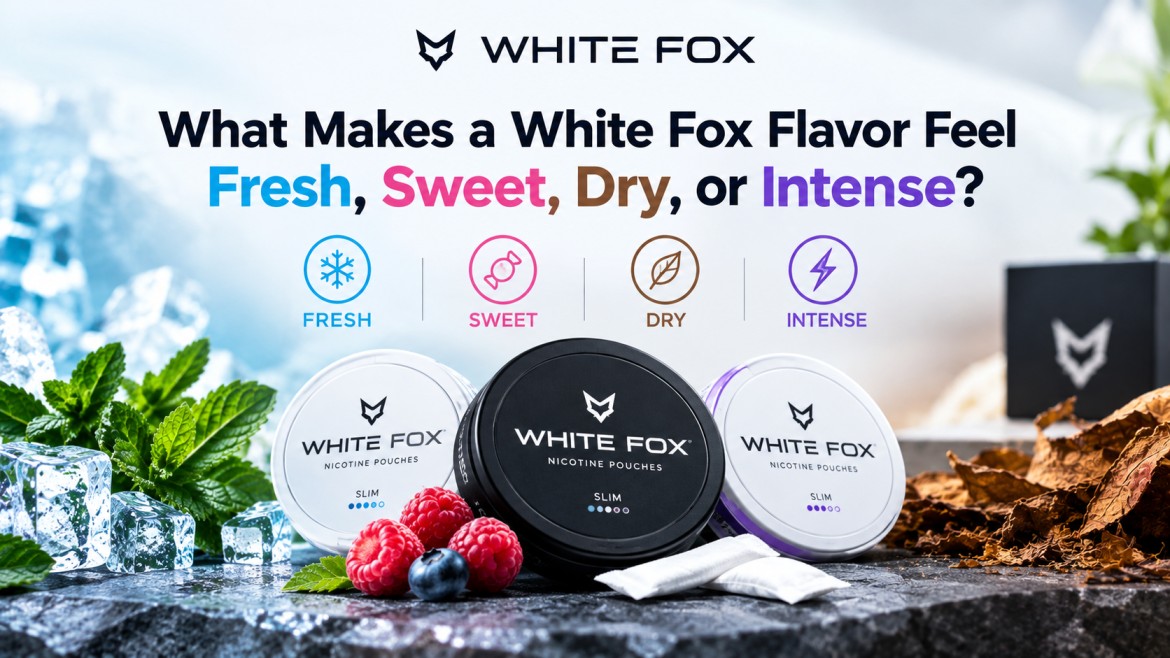
Freshness is primarily a cooling or crisp impression. When someone calls a White Fox flavor fresh, they’re usually responding to a combination of mint character, menthol-style cooling agents, and aromatic clarity. The sensation tends to feel clean, open, and sometimes slightly brisk, similar to the way cold air feels different from warm air even at the same temperature. Importantly, flavor freshness has nothing to do with product freshness, which refers to whether a can is new or old.
Sweet
A sweet flavor note creates a rounded, sometimes fruit-like or candy-adjacent impression. Sweetness in a nicotine pouch comes from the flavoring profile rather than added sugar, and it tends to make an overall experience feel smoother and fuller. It softens sharp edges, which is why sweet flavors often feel more approachable to people who are newer to pouches or coming from a flavored vaping background.
Dry
Dry is the opposite end of the sweetness spectrum. A dry flavor is less rounded, sometimes slightly earthy, occasionally tobacco-like in character, and tends to finish without much lingering sweetness. It doesn’t mean the pouch itself is physically drier in terms of moisture. It’s purely a sensory description of how the flavor resolves at the back of the palate, the way a dry wine finishes differently from a sweet one despite being the same liquid temperature.
Intense
Intensity refers to how noticeable the flavor feels overall. A highly aromatic profile can feel intense even when the nicotine strength is moderate. Conversely, a high-strength pouch with a muted flavor formulation might feel less intense on the flavor side. These are genuinely separate axes. A pouch can be fresh and mild, or fresh and intense. Sweet and gentle, or sweet and overwhelming. Understanding this distinction matters when you’re choosing between options like White Fox Double Mint and White Fox Full Charge.
What Shapes the Flavor Experience of a White Fox Pouch?
Several factors interact to produce the final sensory impression, and none of them works in complete isolation. Flavor formulation sets the aromatic foundation. Cooling ingredients layer a physical sensation on top of that. Sweetness levels determine how rounded or sharp the overall character feels. Nicotine strength contributes its own sensation, which can amplify or mute perceived flavor. Pouch format affects how quickly ingredients are released. And your own personal taste sensitivity runs quietly in the background, shaping everything you perceive.
When people describe the same White Fox variant very differently, it’s usually because at least one of these variables has shifted, whether that’s a recent meal, a change in flavor familiarity, or just a natural difference in how strongly they respond to mint or sweetness. None of this means one person’s description is wrong. It means flavor experience is genuinely subjective, and the most useful descriptions account for that.
What Makes a White Fox Flavor Feel Fresh?
Cooling and Mint Characteristics
The clearest driver of a fresh impression is the cooling sensation. Mint flavor and actual cooling are related but distinct. Mint provides an aromatic, herbal quality. Cooling agents, often menthol-adjacent compounds in flavoring formulations, produce a physical chilling effect on the mucous membranes inside the lip and mouth. Together, they create that characteristic rush that makes something feel brisk and clean. A variant like White Fox Peppered Mint builds on this by layering a sharp, almost spiced edge onto the cooling base, which makes the freshness feel more defined and complex rather than simply cold.
Crisp Aromatic Notes
Freshness isn’t always about cooling. Some profiles feel clean and crisp simply because of how their aromatic character sits, open and uncluttered rather than heavy or rich. A lighter aromatic load can create an impression of freshness even when the cooling component is relatively modest, because there’s no warmth or heaviness competing with it. This is worth keeping in mind for anyone who finds strong cooling agents uncomfortable but still wants something that reads as clean and light.
Freshness vs. Flavor Strength
A fresh flavor is not automatically a strong one. A mild mint profile, gently applied, can be unmistakably fresh without being at all aggressive. Meanwhile, a concentrated mint formulation might feel both fresh and intense at the same time. These are additive qualities rather than a sliding scale where one comes at the expense of the other. Choosing based on freshness alone without considering intensity will leave gaps in how accurately you’re selecting a product.
What Makes a White Fox Flavor Feel Sweet?
Sweet Flavor Notes and Their Role
Sweet flavor characteristics come from the flavoring compounds used in the pouch formulation rather than any literal sugar content. These notes might read as fruit-like, candy-adjacent, or simply rounded and soft depending on what they’re built around. They tend to sit at the front of the flavor experience, giving an immediate impression of approachability. For anyone coming from fruit-flavored vaping or pod devices, a sweeter nicotine pouch will feel more familiar as a transition point.
Sweetness and Smoothness
One of the most consistent things sweet flavor notes do is soften the overall character of a pouch. When there’s pronounced sweetness in the profile, sharper aromatic notes and cooling sensations tend to feel less jarring, because the sweetness rounds off their edges. This is part of why certain White Fox variants feel immediately accessible even at higher nicotine levels. The sweetness creates a cushion around the stronger elements.
Sweetness vs. Intensity
A sweet flavor is not necessarily a strong one. A subtle, restrained sweet profile can be quite mild overall, sitting quietly in the background without announcing itself. A highly developed sweet profile with multiple layered notes will naturally feel more present and prominent. The distinction matters because assuming “sweet” means easy or mild can lead to underestimating a flavor that’s actually quite bold.
What Makes a White Fox Flavor Feel Dry?
Less-Sweet Flavor Profiles
Dryness is most often a consequence of reduced sweetness rather than a deliberately engineered characteristic. When the sweet layer is absent or minimal, the remaining flavor notes resolve differently at the palate. The finish tends to be crisper and less rounded, which registers as dry. For users who find sweet flavors cloying or who are looking for something that doesn’t linger with a fruity or candy-like aftertaste, a dry profile offers a cleaner resolution.
Earthy and Tobacco-Like Notes
Some flavors carry genuinely earthy or roasted notes that contribute to a dry impression through their character rather than just the absence of sweetness. White Fox Black Edition moves in this direction, offering a deeper, more tobacco-associated character that finishes drier than the mint-forward variants. It’s worth being clear that dry isn’t a criticism. For users who find sweet mint profiles too dominant, a drier flavor character is exactly what they’re looking for.
Dry Finish vs. Dry Mouth
There is a genuine difference between a dry flavor finish and any physical experience of mouth dryness. A dry finish is a sensory descriptor: the flavor resolves without sweetness or lingering richness. It’s a palate description, the same way a dry martini or dry wine describes character, not hydration. These sensory descriptions shouldn’t be read as statements about physical effects, which fall under entirely separate considerations.
What Makes a White Fox Flavor Feel Intense?
Strong Aromatic Presence
The most common driver of perceived intensity is a prominent aromatic profile. When the flavor notes are bold and clearly defined from the moment the pouch is placed, the impression of intensity is immediate. Several notes working together in a concentrated way tend to feel more pronounced than a single note applied lightly, even if the individual ingredients are the same. This is why some White Fox variants feel fuller and more present despite not necessarily carrying higher nicotine content.
Cooling Intensity
Strong cooling amplifies the perception of intensity in a way that’s almost physical. When the cooling sensation is prominent, it draws your attention to the pouch and to the flavors associated with it. This can make the overall experience feel more significant than a softer cooling layer would. It’s worth distinguishing here: cooling intensity makes the experience feel notable and present, but it doesn’t change the underlying flavor character beneath it. A very cool pouch can still have a relatively simple flavor profile.
Flavor Concentration and Perception
Perceived intensity ultimately comes down to how well the total flavor package commands your attention. A concentrated formulation with a clear identity will register as intense. A diffuse, muted formulation will sit in the background. This is shaped by the balance of notes, their relative prominence, and how they interact with cooling and sweetness, rather than any single ingredient pulling everything up on its own. You can read more about how different variants approach this in the White Fox flavor review on the site.
Flavor Intensity vs. Nicotine Strength
This distinction is important enough to state directly. Flavor intensity and nicotine strength are not the same thing, and conflating them leads to consistently poor product choices.
Flavor intensity describes how noticeable, how present, how defined the taste experience feels. Nicotine strength describes the labeled amount of nicotine in the pouch and the kind of sensation that delivers. A lower-strength variant can have a bold, highly present flavor character that demands your attention.
A higher-strength variant can have a relatively muted, background-level flavor that sits quietly while the nicotine sensation does the work. For a detailed breakdown of what the numbers actually mean, the guide to nicotine strength in White Fox pouches covers this thoroughly. Never use perceived flavor strength as a proxy for selecting nicotine level, and never assume that a strong flavor means a more potent product in any nicotine sense.
How Different Flavor Elements Work Together
Fresh + Sweet
When cooling and sweetness appear together, the result is typically a bright, easy-drinking profile that appeals broadly. The sweetness softens the cooling edge and the cooling stops the sweetness from feeling heavy. The combination feels accessible without being dull, which is part of why it’s a common flavor design direction.
Sweet + Fruity
Sweet notes built around fruit associations tend to create a fuller, more layered impression. The fruitiness adds dimension to the sweetness rather than just amplifying it, which gives the flavor something to resolve toward at the back of the palate. These profiles often feel the most rounded and complete.
Fresh + Intense
When strong cooling or concentrated mint sits at the center of a flavor, the result feels particularly prominent. White Fox Double Mint works in this space, layering two distinct mint expressions to create a profile that’s definitively fresh and notably present without requiring sweetness to feel substantial. The Double Mint review breaks down how those layers interact.
Dry + Intense
A dry, intense profile is the most acquired of the combinations. Earthy or tobacco-associated notes can feel pronounced without any sweetness or cooling to soften them, and the result lands differently from every other combination. Users who find mint-forward flavors too dominant often find this direction more satisfying precisely because the intensity comes from character rather than sensation.
Balanced Profiles
Not every White Fox variant is designed to lean heavily in one direction. Some are built to balance contrasting characteristics so that no single element dominates, giving you a composed, all-round experience that works across different contexts and times of day.
Why the Same White Fox Flavor Can Feel Different to Different People
Taste and smell perception vary significantly between individuals. Sensitivity to menthol and mint compounds, for example, differs based on genetics and exposure history. Someone who grew up using mint-heavy products regularly will likely perceive the same cooling level as less dramatic than someone trying it for the first time. The same applies to sweetness sensitivity and to how strongly someone responds to earthy or tobacco-adjacent notes.
Your flavor history matters too. If you’ve been using fruit-forward pods or devices for the past year, a dry tobacco-adjacent profile will feel more dramatic in contrast than it would to someone who switched from cigarettes. Recent food and drink can shift things even within a single day: coffee tends to suppress sweetness perception, spicy food amplifies cooling sensations, and anything citrus-forward can make mint profiles feel more complex. None of this makes any description wrong. It’s just the reality of how perception works, and it’s worth factoring in when you read flavor reviews, including this one.
How Food and Drinks Can Change Flavor Perception
The interaction between recent consumption and nicotine pouch flavor is real and often underappreciated. Coffee is particularly notable: it can make sweetness feel more muted and earthy notes feel more prominent, which means a sweet profile used after coffee might read as closer to neutral than it would in isolation. Spicy foods heighten sensitivity to cooling sensations, so a fresh mint flavor might feel more intense after a spiced meal than it would first thing in the morning. Citrus flavors can brighten mint profiles and make them feel more complex, while heavily sweet foods can make even sweet pouches feel comparatively flat afterward.
None of this requires you to manage your diet around your nicotine pouches. It’s simply useful context for why the same product doesn’t always feel identical, and why comparing two variants immediately after eating will give you a different impression than comparing them on an empty palate.
How Flavor Familiarity Can Change Perceived Intensity
There’s a well-documented phenomenon in sensory science where repeated exposure to a stimulus reduces its perceived intensity over time. The same principle applies to nicotine pouch flavors. A variant that feels strikingly fresh or intensely minty the first time you try it will typically feel more restrained after regular use, not because the pouch has changed but because your perceptual system has recalibrated around it.
This is worth knowing for two reasons. First, it explains why a flavor that seemed too strong when you first tried it might become your everyday preference after a few weeks. Second, it means that rotating between distinct flavor profiles, for example alternating between a fresh mint variant and a drier, deeper option, can help keep both feeling more present and defined. Switching keeps your palate from fully adapting to either one.
Does Duration of Use Change the Flavor?
Yes, and in a fairly predictable way. Most White Fox pouches have an opening phase where the initial flavor and cooling hit are at their most defined. This typically settles within the first few minutes into a steadier mid-use character that’s less intense but more consistent. Toward the end of a session, the flavoring gradually depletes and the impression becomes progressively lighter, sometimes with a faint aftertaste that extends slightly beyond removal.
Duration and intensity are separate things. A pouch with a highly intense initial impression might fade relatively quickly, while a more moderate profile might hold steady for a longer window. If lingering flavor matters to you, it’s worth paying attention to mid-use character rather than forming opinions based on the opening rush alone.
How to Describe a White Fox Flavor More Accurately
If you want to get better at choosing pouches or explaining your preferences, working through a simple sensory sequence helps:
- Dominant flavor: Identify the primary impression: mint, fruit, tobacco, or something else.
- Sensory character: Does it read as fresh, sweet, dry, or relatively neutral?
- Intensity: Assess separately. How strongly does the flavor present itself, independent of what it is?
- Cooling: Is there a physical cooling sensation, and if so, how prominent?
- Finish: How does the flavor resolve at the back of the palate?
- Duration: How long does the flavor remain clearly perceptible during use?
Useful vocabulary to describe what you find: crisp, cool, sweet, fruity, minty, dry, earthy, smooth, sharp, aromatic, lingering, mild, pronounced. Using specific terms gives you more useful information than “strong” or “weak” alone.
Fresh vs. Sweet vs. Dry vs. Intense: Quick Comparison
| Characteristic | Typical Sensory Impression | Common Drivers |
|---|---|---|
| Fresh | Cool, crisp, clean, brisk | Mint flavor, cooling agents, open aromatics |
| Sweet | Fruity, rounded, smooth, candy-adjacent | Sweet flavor notes in formulation |
| Dry | Less-sweet, deeper, earthy finish | Reduced sweetness, tobacco-adjacent or roasted notes |
| Intense | Highly noticeable, prominent, defined | Strong aromatics, cooling intensity, concentrated formulation |
| Smooth | Balanced, without sharp edges | Sweetness softening sharper notes |
| Lingering | Flavor remains noticeable well into use | Flavor concentration and release rate |
A single variant can fall into multiple categories simultaneously. A pouch can be both fresh and intense, or both sweet and lingering. These characteristics combine rather than compete.
Common Misunderstandings About White Fox Flavor
Strong Flavor Means High Nicotine
These are independent variables. A bold, highly defined flavor profile tells you about the flavoring formulation, not about nicotine content. The nicotine strength guide explains what the actual numbers mean and how to select based on them accurately.
Fresh Means the Pouch Is Fresher
Fresh as a flavor descriptor means cooling, crisp, and clean in character. It’s a description of how the flavor profile was designed, not a comment on the can’s age or whether the product has been stored correctly.
Sweet Means Mild
Sweetness can coexist with a highly intense, fully developed flavor profile. Some of the bolder White Fox variants carry noticeable sweet notes alongside their cooling intensity. A sweet flavor is not automatically a gentle one.
Dry Means Bad
Dryness is a flavor characteristic with its own appeal. Users who find sweet mint profiles overwhelming often specifically seek out drier, more grounded options. Neither character is objectively better. They serve different preferences.
Intense Means Better
Intensity is descriptive, not a quality judgment. The right level of intensity depends entirely on your preference and the context in which you’re using the pouch. A mild, understated profile may be exactly what you want in a given situation.
Frequently Asked Questions
What makes a White Fox flavor feel fresh?
Freshness comes from cooling agents, mint flavor notes, and a clean aromatic character that creates a brisk, open impression on the palate.
What makes a White Fox flavor taste sweet?
Sweet flavor notes in the formulation create a rounded, fruity, or candy-like impression. Sweetness tends to make the overall experience feel smoother and more approachable.
What does a dry White Fox flavor mean?
Dry describes a flavor that finishes without significant sweetness, often carrying earthier or more neutral notes. It’s a sensory character description, not a comment on moisture.
Does intense flavor mean higher nicotine?
No. Flavor intensity and nicotine strength are separate. A bold flavor can appear in a moderate-strength pouch, and a high-strength pouch can have a relatively subtle flavor profile.
Why does the same White Fox flavor taste different to different people?
Individual variation in taste and smell sensitivity, flavor familiarity, and perceptual history all influence how a flavor lands. There’s no single correct experience for any given variant.
Can food or drinks change how a White Fox flavor feels?
Yes. Coffee, spicy foods, citrus, and sweet foods can all temporarily shift how sweet, cool, or intense a flavor appears. The effect is temporary but real.
Can one White Fox flavor be both sweet and fresh?
Yes. Multiple sensory characteristics can coexist in the same profile. A flavor can be cool and sweet, or fresh and intense, simultaneously.
Why does a flavor become less noticeable after repeated use?
Sensory adaptation reduces perceived intensity with repeated exposure. Rotating between distinct profiles helps maintain sharper perception of each.
Conclusion
Fresh, sweet, dry, and intense aren’t interchangeable labels or points on a single scale. They describe genuinely different aspects of how a White Fox flavor lands: freshness through cooling and crispness, sweetness through rounded and fruit-like notes, dryness through the absence of sweetness and the presence of deeper character, and intensity through how prominently the overall flavor profile presents itself. These can overlap freely, and most of the more interesting variants sit at the intersection of two or more of these qualities.
The one distinction worth keeping front of mind through all of this is that flavor experience and nicotine strength are separate. Choosing a product based on how bold the flavor feels is a valid reason to make a selection, but it tells you nothing reliable about the nicotine level you’re getting. Use them as separate criteria. Browse the full White Fox nicotine pouches range at White fox Dubai with these sensory distinctions in mind, and you’ll have a much more reliable framework for finding what actually works for you.