
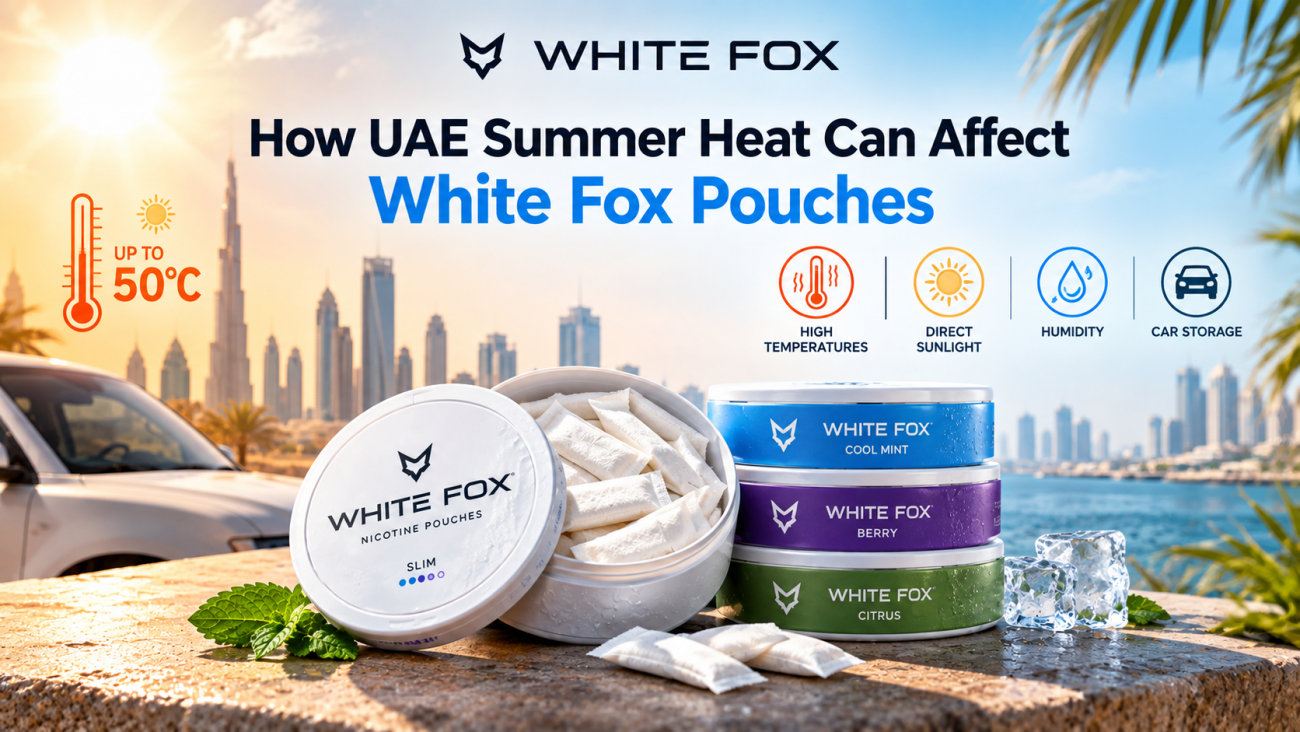
Anyone who lives in the UAE knows that summer here isn’t just warm and it’s punishing. By late morning in July or August, outdoor temperatures regularly push past 43°C, parked cars turn into ovens within minutes, and anything left in direct sunlight suffers for it. For most personal items, we account for this without thinking. We don’t leave chocolate in the car. We don’t keep medicine on a windowsill. But nicotine pouches often get overlooked, and that’s where problems start.
If you use White Fox nicotine pouches, it’s worth understanding what UAE summer conditions can actually do to the product. Not in a vague “heat is bad” way, but specifically: what changes, why it changes, and what you can do to prevent it. This guide covers all of that, from the science of what heat does to moisture-containing products through to practical storage habits that work in a Dubai or Abu Dhabi context.
Why Temperature Matters for Nicotine Pouches
White Fox pouches work the way they do because of a precise balance between moisture, flavoring compounds, and the physical properties of the pouch material itself. That balance is what gives each variant its characteristic texture when it sits against the gum and its flavor release during use. Temperature affects all three of those elements, and the effect compounds with time.
Moisture Loss and What It Does to Texture
Heat accelerates evaporation. A pouch that sits in a hot environment for long enough will lose moisture content, not dramatically in a single afternoon, but meaningfully over repeated exposure or sustained heat. The result is a pouch that feels drier and firmer than it should. It doesn’t conform to the gum as comfortably, and the gradual release of flavor and nicotine that depends partly on adequate hydration becomes less consistent. Users who are familiar with a product will often notice this before they can articulate what’s wrong. The pouch just feels off compared to what they know.
What Happens to Flavor and Aroma
The aromatic compounds that give White Fox variants their distinct character are volatile by nature. That’s what makes them aromatic. They release into the air easily, which is also why heat drives them off faster than normal. A can of White Fox Double Mint stored correctly has a recognizable, crisp mint scent when you open it. The same can after a week on a hot car dashboard may smell noticeably flatter. That’s not packaging failure. That’s the aromatic compounds dissipating under heat before you’ve even opened the can.
Flavor perception during use follows the same pattern. The cooling freshness that defines mint-forward variants depends on volatile aromatic delivery. When those volatiles have partially escaped, the experience feels duller: less defined and less immediate. The pouch hasn’t spoiled in any meaningful sense, but it doesn’t perform the way it was designed to.
Brief Warmth vs. Sustained Exposure
This distinction matters because it changes how you should think about storage. Carrying a can in your pocket on a hot day, or leaving it in a bag for a few hours while you work, is not the same as leaving it on the car dashboard for three consecutive days. Incidental warmth is unlikely to produce noticeable change. Sustained exposure in an enclosed space, particularly a vehicle interior in UAE summer, is a different matter entirely. The concern is with scenarios where the product experiences prolonged heat, not every moment of warmth.
What Makes UAE Summer Conditions Specifically Problematic
The UAE’s summer creates a combination of factors that don’t exist in most climates, and understanding them helps explain why storage habits that work fine in Europe or East Asia can fail here.
Vehicle Interiors Are Extreme Environments
A car parked in direct sun in Dubai in July can reach interior temperatures of 70°C or higher within an hour. The dashboard and center console are among the hottest points. This isn’t a mild elevation above ambient temperature. It is an extreme environment that no consumer product storage recommendation would endorse. The glove compartment offers partial insulation from direct sunlight but still climbs to temperatures that will affect any moisture-sensitive product left there over hours.
This is the most common way UAE residents inadvertently damage their pouches. It’s easy to leave a can in the cupholder when you step out quickly. In UAE summer, even a short stop can push the product well beyond where it should be. The simplest habit to develop: take the can with you, or leave it at home. A pocket or a bag provides significantly better insulation than a parked car interior, even outdoors in the heat.
Temperature Swings Between Indoors and Outdoors
UAE life involves constant movement between heavily air-conditioned interiors sitting at 20°C or below and outdoor environments that may be 45°C or more. When a cold product moves into a warm, humid environment, condensation forms. Moisture from the air deposits itself on and inside the container. If this happens repeatedly, the cumulative effect on the pouches can be moisture inconsistency: the upper layer of pouches may feel damper than normal while the overall aromatic quality is still declining from heat exposure during outdoor periods.
This isn’t a reason to avoid air conditioning. It’s a reason to keep the container sealed, minimize unnecessary transitions, and not treat your nicotine pouch can like something that lives half in the car and half in the office.
Direct Sunlight Adds a Separate Layer of Damage
Sunlight doesn’t just carry heat. It also delivers UV radiation that can affect packaging materials and surface temperatures independently of ambient air temperature. A surface in direct afternoon sun in the UAE can run 15 to 20°C above the surrounding air temperature. A can sitting on a sunny windowsill in the late afternoon isn’t just sitting in a warm room; it’s sitting on a surface that may be pushing 60°C. The packaging isn’t designed for that, and neither is the product inside it. Shaded indoor storage eliminates this risk without requiring anything more complicated than keeping things in a drawer.
How Flavor Freshness Changes Under UAE Summer Heat
The freshness of a nicotine pouch, that quality that makes opening a new can feel clean and immediate, is closely tied to aroma retention and moisture balance. Both are sensitive to heat.
Mint and Cooling Variants Feel It Most Noticeably
Products built around cooling and crispness, like White Fox Full Charge or White Fox Peppered Mint, are particularly easy to evaluate in this context because freshness is the whole point. When heat strips away some of that aromatic character, the gap between expectation and experience is immediately obvious. You know what these variants should feel like, and you notice when they don’t. That doesn’t mean every flavor difference you notice during summer is a storage problem. But if you can trace a specific exposure event, heat is a likely contributor.
Deeper Profiles Are Less Obvious But Still Affected
Variants with a less volatile aromatic character. White Fox Black Edition sits in drier, tobacco-adjacent territory and may show less obvious aroma loss simply because the profile isn’t built around brightness and immediacy. That doesn’t mean they’re unaffected. It means the change is subtler and less immediately detectable. Proper storage matters for all variants equally, even when the consequences are easier to spot with some than others.
When It’s Not a Storage Issue
Heat isn’t the only explanation for flavor variation, and it’s worth keeping the other possibilities in mind. Sensory adaptation, the way a familiar flavor becomes less vivid with repeated use, accounts for a large part of what people describe as their product “getting weaker” over time. Dehydration, which is common in UAE summer, also changes taste perception independently of product condition.
Recent food and drink can shift the palate significantly. Before concluding that a storage problem has affected your product, rule out these simpler explanations. If you haven’t been exposed to an obvious heat event, the variation is more likely perception than product condition. The White Fox flavor review covers how individual perception affects the experience in more detail.
How to Store White Fox Pouches During UAE Summer
Good storage during summer isn’t complicated. The goal is a stable, cool, shaded, dry environment. Those conditions are readily available in any air-conditioned home or office in the UAE.
Where to Keep Them at Home
A closed drawer or cupboard in any air-conditioned room works well. Keep them away from the kitchen, where oven and cooking heat raises ambient temperatures, and away from windows that receive direct afternoon sun. A bedside drawer, a desk drawer, or a closed shelf in a shaded room are all fine. The location doesn’t need to be cold. It just needs to be consistently within a normal indoor temperature range and shaded from direct light.
What About Refrigeration?
This comes up regularly, particularly during UAE summer, and the instinct behind it makes sense: if heat is the problem, surely colder is better. The reality is more nuanced. Refrigerating a product and then moving it into a warm room, which is what happens every time you open the fridge to take one out, creates condensation. Cold product, warm air, moisture deposits on the surface and inside the container. If you do this repeatedly, you’re trading a heat problem for a condensation problem.
Unless the manufacturer’s storage guidance specifically recommends refrigeration, a stable cool room temperature is a better choice than cycling between fridge and ambient heat. Consistency matters more than absolute coldness. If you live somewhere in the UAE with reliable air conditioning and can keep your home at a stable indoor temperature, that’s sufficient.
Keeping the Container Properly Sealed
The lid exists for a reason. Leaving an open container sitting out between uses exposes the pouches to ambient air, which in UAE summer means warm, humid air that doesn’t do the product any favors. Closing the lid firmly after each use is the simplest single habit that protects against both moisture loss and humidity-related issues. It takes one second and makes a real difference over the course of a can.
Recognizing Possible Heat-Related Changes
If a can has been exposed to significant heat, there are usually a few signs worth looking for before assuming the product is unchanged:
- Texture: Pouches feeling drier, firmer, or less pliable than you’d normally expect from that variant.
- Opening aroma: Noticeably less scent than usual when you first open the can. Mint profiles should have a clear, immediate fragrance.
- Flavor during use: Flatter, less defined, or missing the characteristic freshness or cooling of the variant you’re using.
- Condensation inside the lid: Visible moisture that suggests temperature cycling has occurred.
- Packaging condition: Any warping, loosening of the lid, or changes to the container shape that might suggest extreme heat exposure.
One of these in isolation doesn’t confirm damage. Several together, particularly after a known heat exposure event like leaving the can in a parked car, paint a clearer picture. A product that shows significant changes on multiple fronts after a high-heat storage situation has probably been affected.
UAE Summer Storage: Common Mistakes and How to Avoid Them
The Car Is Not a Storage Location
During UAE summer, the interior of a parked vehicle is one of the most damaging environments you can expose any moisture-sensitive product to. It applies to the dashboard, the glove compartment, the center console, and any surface that’s enclosed and sun-exposed. If you’re driving to work and back, don’t leave the can in the car. If you’re going shopping, take it with you. It takes no time and removes the single biggest source of summer heat damage for most users.
Windowsills and Countertops in Direct Sun
An indoor location can still be a bad storage choice if it’s in direct sunlight for part of the day. A kitchen counter under a west-facing window in the afternoon, a bathroom shelf that gets direct morning sun, or a desk positioned near a sun-exposed window can all expose products to localized high temperatures that exceed what the overall room temperature would suggest. Move the product to a shaded location: a drawer, a cupboard, anywhere that doesn’t receive direct light.
Leaving the Container Partially Open
An opened can left out on a desk or table isn’t just exposed to whatever temperature the room is running at. It’s also exposed to humidity in the air, which in UAE summer is substantial, particularly in coastal areas. This combination gradually degrades the product in ways that proper storage would prevent. Close the lid. It’s the simplest habit with one of the most consistent payoffs in terms of product condition.
UAE Summer Storage Quick Reference
| Storage Factor | Do This | Avoid This |
|---|---|---|
| Temperature | Cool, air-conditioned indoor space | Car interiors, outdoor storage, hot rooms |
| Sunlight | Shaded drawer or cupboard | Windowsills, sun-facing surfaces |
| Vehicle | Take the can with you when leaving the car | Dashboard, glove compartment, cupholder |
| Container seal | Lid firmly closed between uses | Leaving open on a desk or countertop |
| Humidity | Dry indoor environment, sealed container | Exposed to outdoor air or coastal humidity |
| Temperature transitions | Keep storage conditions consistent | Repeated fridge-to-hot-car cycling |
Frequently Asked Questions
Can UAE summer heat affect White Fox pouch flavor?
Yes. Prolonged heat exposure reduces the aromatic compounds responsible for freshness and flavor definition, making the experience noticeably flatter.
Can White Fox pouches dry out from heat?
They can. Sustained heat accelerates moisture loss, which changes the texture and affects how flavor is released during use.
Is it okay to leave White Fox pouches in a car during UAE summer?
No. Vehicle interiors in UAE summer reach temperatures that are damaging to moisture-sensitive products. Take the can with you or leave it at home.
Should I refrigerate White Fox pouches during summer?
Unless the manufacturer recommends it, a stable cool indoor temperature is better than refrigeration. Repeated fridge-to-warm transitions cause condensation that can affect the product.
How do I know if a pouch has been affected by heat?
Look for noticeably drier texture, reduced aroma when opening the can, and flatter flavor during use, particularly after a known heat exposure event.
Does every pouch exposed to heat become unusable?
Not automatically. Brief, incidental warmth is unlikely to cause significant change. Sustained extreme heat, like several hours in a parked car, is more likely to produce noticeable effects.
Does high humidity matter too?
Yes. UAE coastal humidity can interact with unsealed or partially open containers. Keeping the lid closed eliminates most of this risk.
Where is the safest place to store White Fox pouches at home?
A closed drawer or cupboard in an air-conditioned room, away from windows and heat-producing appliances.
Conclusion
UAE summer heat creates genuine storage challenges for White Fox pouches, but they’re all avoidable with straightforward habits. The core risk isn’t being outdoors on a hot day. It’s leaving products in enclosed, sun-exposed environments like parked cars, on windowsills, or in poorly shaded outdoor spaces for extended periods. That’s where moisture loss, aroma degradation, and texture changes actually happen.
Keep the can sealed, store it in a shaded air-conditioned space, and avoid leaving it anywhere that consistently gets hot. Do those three things and the product stays in the condition it was designed to be used in, from the first pouch to the last. Browse the full range of White Fox nicotine pouches at White Fox Dubai Online shop and make storage a habit that runs alongside your other summer routines in Dubai and across the UAE.